Fixing ethernet
11 October 2025Back in 2021 when a disused room was converted into an office part of the work involved running Ethernet cabling between the two ends of the house, but after some odd network behaviour investigation revealed that one of the four twisted pairs had a break. As a stop-gap a fast-Ethernet switch was used to limit speeds to 100 mega-bit as this only needed two of the four twisted pairs, and in practice the speed limitation was not an issue in practice so fixing the underlying break ended up on the back-burner. Later problems with VPN connections which were solved by reducing the MTU size and this was — most likely incorrectly — put down to the lack of jumbo frames with 100 mega-bit networks, but regardless of the correctness of this conclusion fixing the underlying broken connection finally made it onto the agenda late-2024.

As with many other things the problem was competition for the spare time so this broken pair only finally got fixed today. Unlike the balcony pigeon problem this was not an immediate problem so for various reasons it got repeatedly pushed out, but this is the last time I expect to be around for at least a month so if not fixed it would likely not be looked at again until new-year.
Removing an attic segment
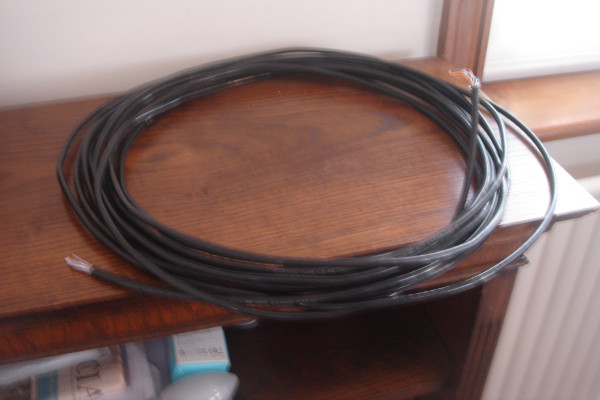
At first it was thought that the break was somewhere in the attic but cutting the cabling and testing that segment showed this to not be the case. However when the room was decorated a very generous excess slack had been pulled into the attic rather than cut away as I thought it would be, so having cut the cabling for testing purposes the opportunity was taken to remove an eleven meter section of this slack and splice together the remaining cabling. This was roughly a quarter of the originally installed length and while it is doubtful any reduced attenuation would make any real difference in practice, there was no up-side for keeping this much surplus length in place.
Rewriting the socket
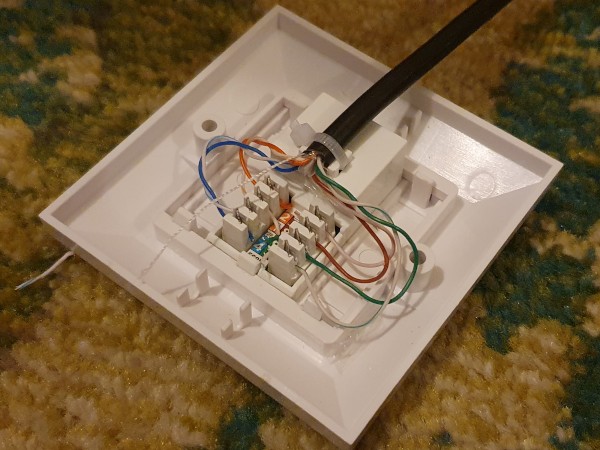
At this point it was feared the break might be in the part of the cabling that had been embedded during redecorating but as a next step that involved both the least harm and least effort, the connection to the socket on the wall face-plate was checked. The existing wiring was cut away and checking continuity with a multi-meter verified that the break was within the untwisted wire around the socket termination block. Previously the face-plate had been wired with the wire ends on the outside of the terminal block, but this time round the untwisted ends were made a lot longer with the wires going around the outside as shown in the picture below. It took more than one attempt at rewiring but at least the rest of the cable was now known-good.
When the wall socket was first wired a large but now forgotten amount of slack was left, but for better or worse this was left in-situ as shortening it would require taking up a floor-board to make sure nothing was snagging it. The floorboard concerned was only a short length but it had a large rug on top and this in turn had a lot of furniture on top of it, and I was not going to risk blindly pulling out excess length. Connecting a workstation directly to the socket verified gigabit connectivity was working so a final step is to replace the fast Ethernet switch with a gigabit switch, but since there is not a spare one at hand this will be done another time.